
Kaizen - Continuous Improvement
Kaizen is a Japanese term that has brought to life a living methodology of scalable improvement that can be adopted in your everyday life as well as your business.
9/19/20255 min read


Here’s how you can start applying Kaizen in your business or daily life:
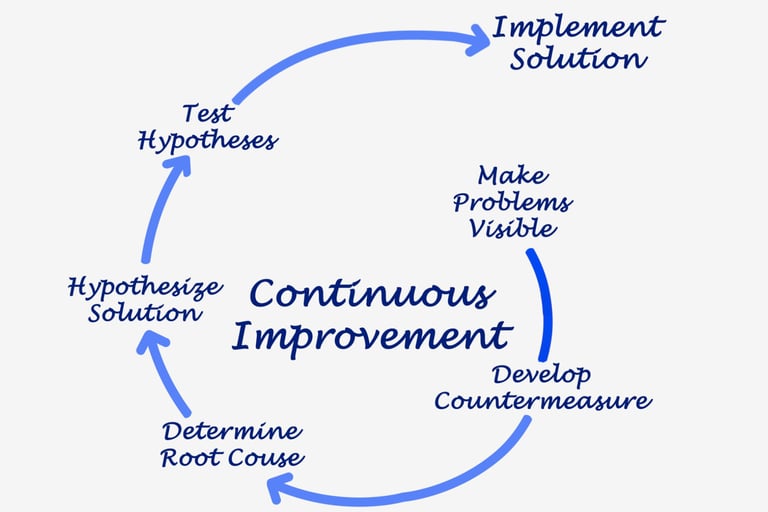
1. Identify losses and opportunities: Encourage everyone, at all levels, to look for areas that can be improved. This step requires humility and openness. Leave ego at the door and listen to feedback honestly.
Even the simplest 1-minute quick pow-wow can become an effective tool. In an SME Lean Business Logic Ltd were supporting, a quick morning meeting for the customer service team, where every employee got to bring a difficult client to the table, allowed for greater collaboration and quicker resolutions to customer issues. Staff were happier and less stressed, customers were happier, and they saw an uptake in return business.
2. Develop solutions: Use simple tools like the 5 Whys to uncover root causes. Don’t overthink it. Sometimes the smallest adjustment makes the biggest impact.
If finding the problem is a challenge, sometimes it’s easier to look for the solution you want to see. What is your ideal? For the business? For the client? Remember to work back in incremental steps. This is a simple way to begin to implement change you weren’t necessarily looking for.
3. Implement and Sustain changes: Take action quickly. In business, this might happen during a focussed event called a “Kaizen Blitz”. In life, it could mean simply starting, progress beats perfection every time.
Client's often express they don't know how to get started. At Lean Business Logic, we remind them they already have by talking to us. Be curious, look for the solutions you don't know exist. Our limits are our imaginations, and what you think may be cutting edge today may well be on it's way out.
4. Standardise Improvements: When something works, make it part of your system. Build it into your daily routine or company process so success becomes repeatable and sustainable.
Toyota have only made Kaizen as successful as it is because they never put it down. The changes never get shelved, they never stop looking at how to improve, they never close the door on employee engagement. What works, keep and apply effectively across areas of business where it holds relevance. Make it your go to for that process.
5. Keep the Cycle Going: Kaizen never really ends. Once one improvement becomes the norm, another opportunity appears. It’s a mindset of always bettering, never standing still.
Revisit. Revisit. Revisit. Kaizen is for continuous development and continued engagement with your clients, with your staff, with the industry. Remember to stay curious and stay open.
Kaizen - Continuous Improvement
Kaizen is a Japanese term meaning change for the better through continuous improvement. It embodies the idea that small, consistent changes made every day can lead to significant long-term results. Think of it as a simple life strategy that encourages you to focus on making small, positive adjustments rather than waiting for a big breakthrough.
“Kaizen doesn’t ask for perfection, it asks for progress, one small step at a time.”
When applied to everyday life, Kaizen becomes a guiding formula for improvement. Whether you want to strengthen your home life, improve your finances or enhance your well-being. Kaizen helps you progress steadily toward your goals.
In business, the philosophy goes even deeper. Kaizen isn’t about top-down management, it involves everyone, from leaders to team members. Everyone’s responsible in finding, creating and implementing improvements that make the entire system better. One of the best-known examples of Kaizen in action is the Toyota Production System, where every employee has the power to suggest or even stop production to improve quality.
Sometimes it’s the simplest employee improvements, for example the popping up of a screw, meaning an employee didn’t have to bend down. Two tenth’s of a second that saved Toyota, however when you carry that over ten million cars a year that’s the same as 560-man hours. The smallest of Kaizen’s, with a huge impact for business and employee.


Key Principles of Kaizen
1. Continuous improvement – At the heart of Kaizen is the mindset of ongoing, incremental, positive change. It’s not about massive leaps forward, just consistent progress. The kind that compounds over time.
2. Elimination of waste (Muda) – This principle encourages you to identify and reduce inefficiency. In business, this might mean tightening up a process, at home, it could be as simple as avoiding late-night doom scrolling. In short, streamline wherever possible.
3. Employee Involvement – Kaizen thrives on participation from everyone. At Toyota, for example, factory workers can stop the production line when they identify a defect, empowering real-time improvements. It’s a principle that values every voice, not just those at the top.
4. Focus on Processes – Rather than obsessing over outcomes, Kaizen teaches us to improve the processes that lead to them. It’s not just about working hard; it’s about working smart so success can be repeated, not just achieved once.
5. Standardised Work – This principle takes what’s already working and refines it. By documenting best practices and sharing them across teams, you create a strong foundation for further improvement. Standardisation doesn’t mean rigidity, it means building on what works, not reinventing the wheel.
The principles are noble, however what are the real-world benefits of the Kaizen philosophy?
Adopting Kaizen can lead to tangible improvements in both business and your personal life.
Increased productivity – Streamline processes and reduced waste naturally boost output.
Improved quality – Efficiency and excellence can go hand in hand.
Reduced Costs – Eliminating waste (muda) lowers operational costs and frees up resources.
Enhance employee morale – When people feel heard and see the impact of their ideas, confidence grows.
Better problem -solving – Collaboration fosters stronger, faster and more creative solutions.
“Kaizen turns problem-solving into teamwork. A collective effort to grow, improve and move forward together.”
Real-World Benefits of Kaizen
These benefits of Kaizen can be achieved anywhere, at home it can be the time saved by picking out your clothes the night before, it is setting up a joint calendar, meal prepping, small changes and adaptations that make tomorrow a little easier. At work, streamlining your emails to prioritise on your behalf, blocking out task time, simple automations that provide room to breathe so creativity can flourish.
Great, we understand the principles, we want the benefits, how can we apply the principles?
Applying Kaizen in Practice:
Kaizen is a system that invites you to collaborate beyond your everyday, to humbly search for ways to improve yourself, your processes and your business. It’s about small, consistent steps that add up to significant change. When you embrace this mindset, you start to see opportunities everywhere. To refine. To improve. To grow.
Take one small step today — improve a process, tweak a habit, or solve a problem. Share your wins, support others, and keep moving forward together. Streamline today, scale tomorrow.
Scale Tomorrow.
Unit 22, 6 Harmony Row,
Glasgow, G51 3BA
info@leanbizlogic.co.uk
0141 488 5550
© 2025. All rights reserved.


Streamline Today.